Where it all started
The story of the Newberry Mansion starts with a fire, the Great Chicago Fire to be precise, that blazing inferno that reduced the young city to kindling and necessitated a near total reconstruction, including of the genteel Near North neighborhood. In fact, the neighborhood around the Newberry Mansion, made up of “a rare collection of elaborate masonry dwellings built for Chicago’s elite” is today the largest group of early post-fire residences remaining in the city. It is part of the Washington Square Park district, centered around the oldest park in the city, that dates back to 1842, when developer Orasmus Bushnell donated the land it was built on to the city.[1]
In the 1850s and 60s the neighborhood was “a hodgepodge of breweries, shipyards, factories and immigrant slums, with a few fashionable homes.” By the time of the fire, it was becoming fashionable, populated mostly by American-born Protestants of English descent who built stately homes. After the fire, which burnt down nearly the entire Near North neighborhood, from the river up to Fullerton, “the wealthy Chicagoans who stayed on the North Side built and rebuilt new brownstones and mansions a few blocks east of Dearborn Street and around the Washington Square Park district, which steadily expanded.”[2]
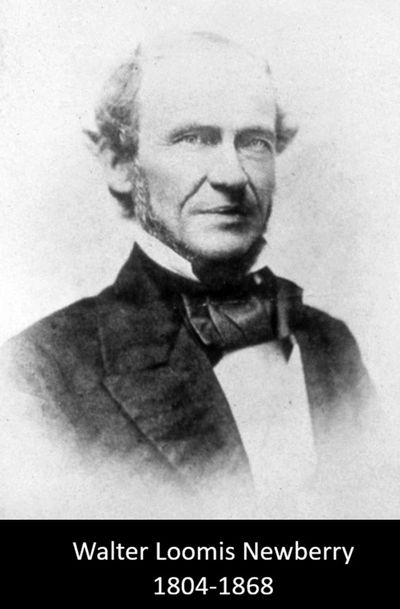
The Newberry Mansion was one of the earlier buildings to be rebuilt in the area. It owes its existence to two men in particular: Walter Loomis Newberry, for whom it is named, and whose fortune paid for its construction over a decade after his death, and architect Frederick H. Waescher.
Walter Loomis Newberry, born in 1804, was a successful merchant and banker who became one of the wealthiest men in Chicago in his time and was an earnest advocate of education.[3]
Newberry was said to be a self-made man. After moving to Chicago in 1833 and seeing the city’s potential, he invested in real estate, buying 40 acres on either side of North Wells Street – including the plot where the Newberry Mansion now stands. The land was bought for a song but became immensely valuable over time. He paid $1,100 for the 40 acres – and its worth ballooned to $2.5 million by the time of his death.
Newberry died at sea in 1868, on an ocean steamer on the way to visit his wife and daughters in Paris. Suffering with consumption, he longed to see his family and thought his health would benefit from a winter in the south of France. Unfortunately, he didn’t even live to see the end of the voyage. His body was preserved for the long trip back home in a large empty rum barrel, and finally buried at Graceland Cemetery.
He left a debt-free estate, consisting mainly of real estate, and estimated at $4-5 million, one-half of which was intended to be used to build the Newberry Library. The Newberry Mansion and the rowhouses that run along Dearborn south of it were also funded by this estate.
Frederick H. Waescher was born in Prussia in 1840. After serving in the Austrian war, he moved to Chicago in 1867 as draughtsman in an architect’s office. Though he returned to Europe during the Franco-Prussian war, once the war ended, he found he wasn’t content with life in Prussia and returned to Chicago. He eventually opened his own architectural firm and was hired in 1875 by the managers of the Newberry estate to design and superintend the construction of their buildings.[4] He designed and oversaw the building of the Newberry Mansion and served as the estate’s architect for more than a decade, specializing in heavy structures, such as warehouses and factories.[5]
Frederick and the estate trustees kicked off construction of the Newberry Mansion and the connected rowhouses in September 1878. It had already been leased for five years to the Barbara and Elisabeth Grant, to use for their school, the Misses Grants Seminary for Young Ladies. A Chicago Tribune article from September 29, 1878, describes the event, stating, “The Trustees of the Newberry estate broke ground during the week for a block of eight fine residences, at the corner of Chestnut Street and North Dearborn street. They will be three stories high, and will have marble fronts. The corner house, 50x60, has been leased for five years to the Misses Grant, who will occupy it with their school.”[6]
The house was designed in the High Victorian Gothic style, in red brick with gray limestone trim and brown ashlar masonry at the ground level. It is highlighted in the American Institute of Architect’s Guide to Chicago as the “Newberry House,” and described as having “Frank Furness-style detailing evident on the corner building’s compressed columns and angled bay.”
[1] City of Chicago website, https://webapps1.chicago.gov/landmarksweb/web/districtdetails.htm?disId=35
[2] National Register of Historic Places Registration Form for Victor F. Lawson House YMCA
[3] Walter Loomis Newberry’s obituary in the Chicago Tribune, 20 Nov 1868.
[4] History of Chicago Volume 3 by Alfred Theodore Andreas
[5] American Institute of Architects Guide to Chicago, Published August 2014
[6] Chicago Tribune, 29 Sep 1878