Bush Conservatory
1918-1932 (approximate)
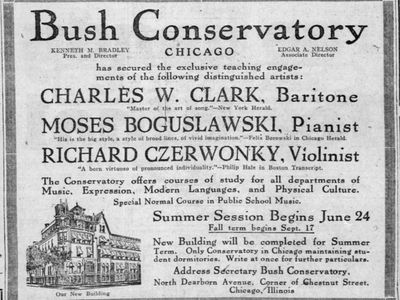
In June 1918, the Bush Conservatory begins to advertise that its new building at 839 North Dearborn would be ready for the summer term. At that time, the Near North neighborhood was home to many music schools. [1]
The conservatory advertised itself as “an institution of national prominence, with the most distinguished faculty, many of international reputation,” including world-renowned baritone Charles W. Clark, pianist Moses Boguslawski, violinist Richard Czerwonky, soprano and opera coach Mme Louise Dotti, and pianist Mme Julie Rive-King. It offered accredited courses leading to certificates, diplomas and degrees in music. Kenneth M. Bradley was President and Director and Edgar A. Nelson was Associate Director of the conservatory at the time. [2]
The Bush Conservatory claimed to be the only conservatory in Chicago with exclusive use of its own buildings and offering dormitories for out-of-state students “with personal supervision” and with or without board. Ads referred to it as the “best equipped and beautifully furnished school in Chicago.” [3]
The Bush Conservatory had been first founded in 1901 by William Lincoln Bush, who had earlier co-founded the Chicago-based piano manufacturer and retailer, Bush & Gerts Piano Company, with his father, William H. Bush, and noted German-born piano-maker, John Gerts. It had first operated in the larger Bush Temple of Music at Clark and Chicago, but it had moved to the smaller location at 839 N Dearborn as interest in musical education declined, “fueled by the new media of motion pictures and records.” [4]
However, the school seemed to remain successful for a time. A 1920 ad says that the demand for Bush Conservatory graduates was greater than the school could fill – and there were more applications than could be accommodated. It described a “congenial, artistic atmosphere” in its student dormitories. [5] By this year it had over 70 instructors. [6] The school claimed that graduates had been engaged as principals in leading productions in New York and Chicago – such as Topsy and Eva, The Student Prince and Romeo and Juliet – and gained positions as high school and college teachers across the country. [7]
Again, the history of the Conservatory intersected with events in the world around our building. In 1921, the Chicago Tribune published an article about a teacher at the Bush Conservatory being separated from her daughters for eight years as a result of World War I. The wife of a wealthy sausage maker in Germany, Mrs. Emmy Ohl had come to Chicago to visit friends in 1914 and was stranded here when the war started. Her husband died soon afterwards, and she became a U.S. citizen. Her children were finally able to join her in Chicago in July of 1921 after staying with an uncle out east for two months. The article says the older daughter, Jiesel gained 15 pounds since coming to the U.S. – where food was much more plentiful than in post-war Germany – and her younger sister Ilse gained 18 pounds. [8]
In 1924, the Bush Conservatory was one of six U.S. institutions that came together to found the National Association of Schools of Music, still operating today. Its purpose was to manage challenges in music education, including the transfer of credits among institutions of higher education. The conservatory’s president, Kenneth McPherson Bradley, took on the role of the association’s founding president until 1928.
Also in 1924, the Bush Conservatory is reported to have merged with the Lyceum Arts Conservatory, a preeminent school of dramatic art and stage craft. Bush absorbed the other institution, including its faculty, equipment, buildings, organization and student body. The merger made the Bush Conservatory the “largest school of the allied arts” in the U.S. [9]
The history of people connected with the Conservatory would no doubt fill volumes. An article in the Chicago Tribune recounts how teacher Charles W. Clark “dropped dead” while sitting next to his wife watching a movie in the Parkway Theater in 1925. While the article states his wife retained remarkable calm and self-possession during the trauma, the shock was apparently too much for her, and she died from a stroke one hour later. [10]
In 1932, the price to board at the Bush Conservatory is advertised as $10-12.5 per week and included a practice piano in the student’s room. [11] This same year, the conservatory merged with the Chicago Conservatory College during the financial pressure of the Great Depression and its name ceased to exist.
Once again, 839 North Dearborn St. was ready for a new purpose.
[1] The Gold Coast and the Slum, Harvey Warren Zorbaugh, 1929
[2] Chicago Tribune, 4 August 1918, page 19
[3] Chicago Tribune, 4 August 1918, page 19
[4] Landmark Designation Report for the Bush Temple of Music at https://www.chicago.gov/content/dam/city/depts/zlup/Historic_Preservation/Publications/Bush_Temple_of_Music.pdf
[5] Chicago Tribune, 28 September 1920, page 22
[6] Chicago Tribune, 1 August 1920, page 60
[7] Chicago Tribune, 20 September 1925, page 94
[8] Chicago Tribune, 24 July 1921, page 11
[9] Chicago Tribune, 14 September 1924, page 85
[10] Chicago Tribune, 4 August 1925, page 1
[11] Chicago Tribune, 18 Jun 1932, page 22